
Elder Trees and the Botanical adventures of a very hungry artist
- Maya Carroll Tischler
- Mar 14
- 9 min read

Updated: Mar 17
What do Faeries, cough syrup and mulching have to do with each other you ask? A question I'm sure many of us have puzzled over... It's the Elder Tree! A useful, magical tree who's whimsy is absolutely off the whimso-meter.

Last week I caught up with my lovely friend Catie and she told me the Elder berries are in season, the perfect excuse for a foraging romp! I’ve often foraged for Elder flowers but am new to the tiny clusters of black berries. This week has been all about learning the language of the Elder Tree, of course a week is not actually long enough to learn a language, so this is the tip of the iceberg! However, I’ve immensely enjoyed my little bit of research and look forward to sharing it with you. Read on to discover: Elder in mythology, Elder in landcare, Elder as tinder and Elder as food and medicine. You can also visit my instagram to see my Elder Berry painting and cooking adventures in 'reel time':
"In medieval England it was said that summer had not arrived until the Elder was in full bloom and that it ended when the berries were ripe."
The scientific name of common elder is Sambucus nigra. - Which I'm pretty sure is the kind I've been foraging, the specific epithet ‘nigra’ means black, and refers to the dark berries that can be found late in summer. It belongs to the Adoxaceae family (having been reclassified from the Caprifoliaceae family). All together there are approximately 20 species in the Sambucus genus. They're apparently native to Europe, Ireland, North Africa, and Southwest Asia. But they have been introduced almost everywhere they can grow and are really common in the British Isles. Here in Australia white colonists brought them from Britain, in some areas they have even become a noxious weed, disrupting areas of native bushland.
Identifying disclaimer:
This blog post is not for identifying the Elder Tree but rather an introduction to it's mythology and many uses (including some scrummy recipe ideas) for if you do happen to meet one, or have one living in your garden.
Here are some great resources to start with if you do want to identify a possible Elder Tree: https://www.treeguideuk.co.uk/elder-tree-identification/
Remember to always reference at least three identifying sources to be sure what you're foraging is not going to kill you, the internet is absolutely your friend here - try to find a few articles that include detailed images.

The Wise Woman, Elder Tree in mythology
In mythology Elder Trees are the crone or wise woman archetype and are significantly associated with witches and faeries in their folklore, often understood as a tree spirit in a very animist sense.
In fact, in Danish folklore the ' Hylde Moer' or Elder Mother, is a spirit who lives inside the Elder Tree (or perhaps is the Elder Tree) it was seen as particularly good luck if an Elder grew near a dwelling, as the Hylde Moer would protect your household. There’s even stories of Elder Trees uprooting themselves and walking around at night, how spooky!
In many British folktales Elder Trees are associated with faeries, it's said if you stand under an Elder Tree on Samhain, you'll be given faerie sight and be able to see them riding past in their glowing procession. As a tree which grows in hedgerows, near roads and at the bottom of gardens, we can see them as a keeper of thresholds and connected to the 'edge of the wild' just like the faerie archetype. It's common belief in Scotland and Ireland that witches and wise woman receive their intuition and magic from the Faeries themselves.
"If you wanted to cut wood from the tree it was necessary to say ‘Old woman give me of thy wood and I will give thee of mine when I grow into a tree’."
In Norse mythology, Elderberries were associated with the goddess Freya, the deity of love, fertility, and old magic. In Britain, Druid's crafted pipes from the hollow stems of Elder wood, making enchanted music. For a long time elders were sacred, no one would even think of cutting one down! This is in stark contrast to their reputation as a weedy shrub now days. Christian myths had their own stories around the elder tree and like a lot of sacred pagan plants, it was suppressed and demonised. I can imagine it's deep mystical and feminine roots may have felt threatening to the new faith. It's one of several trees ‘accused’ of suppling the wood for the Crucifixion Cross, although many point to how weak it's timber is, theorising this myth is probably a later fabrication to denounce the tree.
I live in Australia which means our Elder Trees are introduced and relatively young, so although the elder invokes the wise old woman in European folklore, I see the Elder Tree as a young mischievous maiden. Especially when she flowers, looking to me, like a fluffy wedding gown.
If you're born between the 25th of November and the 23rd of December the Elder Tree is your Celtic Astrology Tree! Those born under this tree are said to be compassionate, philosophical and adventurous, always seeking new experiences.
My Elder Tree Illustration created using gouache and ink on cotton paper
Which is available in my shop as the cutest little print! perfect for adding a touch of whimsy to your abode. I painted this piece in my studio on a beautiful autumn day a week ago, wanting to capture that children's book illustration style. Recently I visited my friend in the 'high country' and they have proper hares up there, which stare at you with quite a wise intensity, they're nothing like the dopey rabbits we are so used to in Central Vic. I knew I had to include one in this painting!
The quest for Biomass, Elder Tree in Land Care
As a tree that can be coppiced, grows well in most cool, semi-moist environments and provides a crop of flowers and berries. I'm quite excited about using Elder Trees in land management for small scale farms or homesteads. The berries and flowers are fiddly to pick and after processing my berries it's abundantly clear why these little gems have never been cultivated in our larger food systems. But they're well worth their time in the context of a household, or collection of households, as a powerfully medicinal and scrumptious supplement.
I'm yet to implement Elder at the farm I'm managing, but plan on planting at least a row as a biomass intercrop for mulching. Within a cool climate context, I'm always looking for plants that put on big seasonal growth that can be chopped and dropped, I'll have to leave this here as a book mark and check back in once I've cultivated my Elder Trees. It's also worth noting Elder's are slightly allelopathic, which means they can release chemicals to inhibit the growth of plants near by, rather than planting them within the food forest - although to be honest, I'm sure it would work fine to, I'm planning on planting a small grove of them in a shady corner of the property.
The Elder Tree's ruling planet could be Saturn, Venus or the moon. -Sources vary.
I also believe they could be a good mix with certain animals, they are definitely connected with rabbits, often growing near (or on) rabbit warrens. - Which is why I included a rabbit in my Elder Tree illustration.
Read more about growing Elder Trees:
'Kindler of fire', Elder Tree as tinder:
With all this talk of wise old women, you might be fairly certain that’s where the name ‘Elder Tree’ originated and you might be surprised (as I was) to find out 'Elder' comes from Anglo-Saxon 'eller', meaning a kindler of fire. I’m really keen to experiment with Elder branches as tinder now. They’re pithy and hollow - iconically bad fire wood said to make the sound of the devil screaming as it burns! However, they have great potential for starting fires. Im looking forward to trying Elder branches as a spindle for fire by friction, as I’ve read it can be used for this! Just another amazing offering from this magical tree.

The culinary forays of a very hungry artist:
Please Note: Elderberry should not be consumed raw off the bush!
Raw Elderberries cause gastrointestinal distress in many people and are toxic.
Elderberries need to be cooked (or fermented) to break down the toxic chemical compounds. There is some discourse around what exactly causes this toxicity, but it is largely considered to be cyanogenic compounds. Cyanide is formed following the hydrolysis of cyanogenic glycosides that occur during crushing of the edible plant material either during consumption or during processing of the food crop.
Best practice to avoid this:
Use only the berries and flowers, all other parts of the tree are toxic and although sometimes used medicinally, are not to be ingested. This includes the tiny stems that support the flowers and berries so take care when processing the berries to remove these.
Cook your Elderberries for at least 15 minutes.
Strain the seeds out of the mixture using a cheesecloth.
Avoid crushing or blending the seeds.





Foraging:
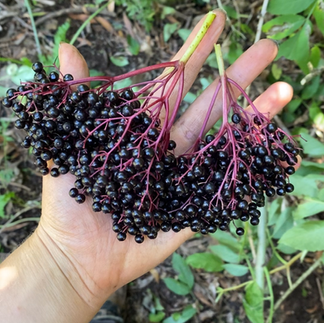
My forays started on Wednesday when I went to my local Elder spot and sure enough, there they were! Big clusters of tiny black berries. I knew that extra care should be taken around these beautiful trees so I wanted to offer something in exchange for the berries. I wrote a slightly higgledy piggledy poem and my partner and I read it aloud to the Elder Trees, they seemed happy with that so we got to business picking the berry clusters and putting them gently in my upturned hat. It was a beautiful crisp autumn afternoon with crystalline rays of sunlight falling through the gum trees overhead, I noticed a rabbit warren in a low bank tucked behind a small Elder, nearly stumbling into it at one point.
As an artist I do feel a sense of pride around the things I create and I'm not even going to share the poem because I've studied enough creative writing to know it wasn't very good, but I also feel the need to mention this because how often does the analytical mind stop us from performing these small acts of creative love? It feels important to continue them anyway, no matter how shoddy or construed they feel, they're an important part of the honourable harvest. An honourable harvest should slow you down, bringing intention and value to the act.



Preserving your Elderberry harvest:
The go-to methods for preserving Elderberries either freezing or drying, due to their low acid content they're often mixed with a 'preservative' like sugar or vinegar to make them shelf stable. The syrup I ended up making isn't shelf stable but can be kept in the fridge and frozen for longer storage.
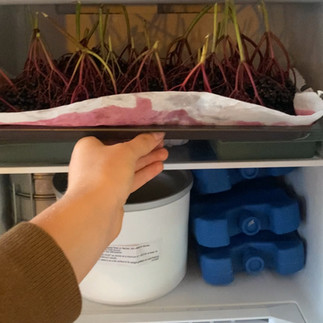
to freeze my ElderBerries I started by carefully removing any berries that weren't black (fully ripe) from the clusters then laying out the umbels on a tray and popping this in the freezer. I then pulled out my tray and 'tickled' the berries off their umbels into a bucket - which I then returned to the freezer, ready for future use!

My culinary forays:
With my Elderberries stashed in the freezer, my culinary forays were off to a good start, or so I thought.
You see, I'm a glance at a recipe once then make it up from there - kinda girl and while stewing up a delicious concoction of elderberries, apple and rhubarb, which I planned to make into a pie, I missed the crucial step of straining the mixture to remove the seeds! Unfortunately because of the pectin in the apples, this pie filling thickened beyond the point of straining. - Ideally I would have stewed the elderberries first, strained them, then added the apple and rhubarb from there.
In the name of science (Don't do this.) I tried a little on a pancake and as expected had a bit of a tummy ache, admittedly I had also just consumed some brie and cheddar cheese, which considering I'm supposed to be dairy-free could definitely have contributed. Oh to be a foodie with the fragile constitution of a toy poodle.
I know I mentioned this above, but the take away is: Do not eat the Elderberry seeds, strain them out!
After a humbling trip to the compost bin, where I deposited my first attempt, I was ready for my redemption round. This time making an Elderberry and honey infusion/syrup.
This is the recipe I followed:
In a pot combine water, Elderberries and any spices such as cardamom, ginger, vanilla pods or cinnamon sticks.
Simmer this mixture for at least 20 minutes, gently stirring.
Take off the heat and strain, I used a nut milk bag, compost the elderberry pulp or make into natural ink for drawing like I did!
Let your beautiful dark liquid cool just enough to add the honey. (Heating honey to high temperatures – generally above 45-50°C – destroys key health benefits by killing the bacteria, enzymes, and antioxidants that make honey so powerful.)
Once you feel happy with the taste, transfer your mixture into sterilised jars and keep in the fridge.
Take just a spoonful in the morning to help fight off sniffles and give that little immune boost!
I now feel ready for Autumn, with my jars in the fridge and some ice blocks in the freezer. Thanks so much for reading to the end! I hope you discover the magic of the Elder Tree in your own life, through listening to your inner seasons and trusting your intuition.

Further Elder Tree reading:

I read all the way to the end! That never happens! Did you cast a spell on me? In awe of the breadth of your knowledge and depth of your imagination, bottomless! You do elder proud 💜