
Five garden design lessons I learned from working as the head gardener at Stone Walls. (the English Garden of your dreams!)
- Maya Carroll Tischler
- 5 days ago
- 7 min read

My job at Stonewalls started casually, a little weeding here, a little planting there, a little why aren't the roses happy? and can you come back and prune the grapevine? Then over the next two years I gradually upped my days and fell in love with both the property and it's people. I was never full time, but (over that time) I was the main gardener and worked alongside the owners and designers Andrew and Georgie who still did the lions share of the work themselves. I came to the job having studied permaculture and not much else, I had no idea how to straighten a hedge, mix concrete, or set up a string line. Simply speaking, before I started working there if you couldn't eat it, I wasn't interested. Since my passion always was and still is around growing food, they started me off in the kitchen garden, I absolutely loved it. Although I quickly learned how difficult it can be integrating the produce from a kitchen garden with a busy family. One time I proudly showed Georgie how to steam and eat artichokes, she was not a fan, she incredulously asked me if I honestly liked them and when I said yes she told me I really am 'of the soil'. I took it as a compliment, but left the artichokes to the bees after that. This post is both an ode to that beautiful property and a record of the design lessons I learned while I was there.
For privacy reasons the photos within this post are not from my time at Stone Walls, however you can check out their instagram and website here: https://www.instagram.com/stonewallsmusk/

Structure is THE MOST overlooked aspect of garden design
Because I get it. - The plants are the exciting bit, the actual garden is the exciting bit, buuuut whats underneath, or around, or next to the plants matters a whole lot more than we think. I will add the caveat that 'structure' matters less in a small backyard, where things like a path, a chicken house or a bbq station create a natural form and flow. However I see a lot of property owners make this mistake when moving to a larger block thats quite open or flat, where simply making garden beds isn't enough. Structure makes the garden intentional and even in the most wild and whimsical gardens it gives the eye a sense of stability.
At Stone Walls Andrew and Georgie used heritage Italian-style stone walls to create strategic borders for both areas of the garden and the path ways. When crafting your structures I would go for rustic elements that look (and are) sturdy - like stone masonry but also, timber sleepers, rusted steel and concrete. As a diehard permie I cannot believe I'm recommending concrete on the internet. I'm not, don't use concrete! Gaia help me. I digress, some other great ideas include large stepping stones, big rocks in general, arbours and arches, trellis', retaining walls, pergolas, large outdoor sculptures, and even a well placed fence.
Places in the garden that offer opportunities to add structure are along paths, around garden beds, as well as where there's a gate or where one area connects to another. Despite what I said at the start of this section, you can use plants to create structure too, think - tall trees, thick hedges, oh and planting plants in groups in general. (Plant at least three or four of the same plant in a clump, it looks so much more intentional. Like a clump of lavenders, or salvias - chefs kiss.)

It's OK to lean on your hero plants
At first I had the instinct to create a completely new planting scheme for each bed we put in, try something I'd never tried before and just absolutely nock everyone's socks off with the creativity of my new plantings. -And to be clear, I do think that should be the gold standard! Thoughtfully considered plants that change within each area, creating a plethora of diversity. Buuuut I kept running up against limits, specifically I had limited time and limited areas of healthy soil.
I learnt that it's ok to fall back on our hero plants. These are generally plants that tick a lot of boxes, they're generally hardy, they might add food and habitat to the garden, or you simply adore the way they look and most importantly they can survive despite your limits. For example if you have limited water, discovering a few drought tolerant plants you absolutely love can make garden design easy as pie.
A good way of discovering your hero plants is to observe whats already working in your garden - the heavy lifting plants that stand out and draw you in. It's also a huge win if you can figure out your hero plant for each niche in your design, like a hero tree, a hero shrub and a hero ground cover. At Stone Walls we had, Japanese Maples, Ornamental Pears, Box and Tuscan Privet hedges, fluffy Westringia bushes and sprawling Pigs Face (a succulent ground cover), as well as rather English rows of Lavender and Hydrangeas. Are they the hero plants I would have chosen? To be honest no, but they thrived within that micro climate and most of all Andrew and Georgie loved them.

The most beautiful gardens are an unfolding journey...
This dawned on me slowly while working at Stone Walls. I noticed that wherever I stood I could see a path that lead somewhere just out of sight, around a hedge or through a garden gate... I know it sounds bit weird when I write it down but the feeling of the garden unfolding as you wandered through it was so magical! Gardens like that are meant to be enjoyed, paths are meant to wind and curve because the natural curiosity of what lies around the bend makes you feel like a child again.
In this way the landscape is balanced but leaves you wanting more, there's symmetry until it eclipses itself and a certain aspect remains just out of sight. Even in a small garden cultivating a sense of journey can be pivotal. Some ways to add this could be through creating paths that wind or snake instead of going straight, aligning buildings or structures to overlap just slightly from certain vantage points, obscuring the next area with a fence or creating portals to the next section, think - an archway covered in climbing roses or two big trees creating a natural arbour overhead.

Design for management and succession, yes I know I'm boring
It's so so easy to get swept up in the excitement of both design and implementing the design, without thinking about management or simply put, because I loath the word 'management', how you're going to interact with the garden and help the garden sustain it's design over the long haul. I like to think of this as working with the natural succession of the garden.
At Stone Walls there are these beautiful white gravel paths, which to my absolute horror the previous gardener kept weed free by spraying glyphosate. Since I'm an organic gardener and I make it very clear to my clients I won't be using herbicides, Andrew and I had to come up with a practical system for keeping the paths looking clean. I ended up using a dutch hoe to scrape out the weeds, it was a bit of elbow grease but I could use it standing up and it worked really well. So while we had found a great solution for the pathways there was this large gravel area outside their house that I thought about all the time... I don't want to know how many hours I spent weeding that area. This is where I have to be really honest about the cost of organic gardening and why smart design pays dividends down the track.
When you're essentially moulding a novel ecosystem to your benefit, some weeding, trimming, pruning, mulching and topdressing is inevitable. However there are many ways you can reduce time spent managing the garden and increase the health of the plants, here I've thought of just a few:
Including ground cover plants and edging plants in garden beds to reduce weed pressure.
Planting native trees or shrubs next to young trees as nurse plants to shield them from harsh sun, frost and wind.
Opting for integrated components like wood chips over gravel, where the broken down chips can be shovelled back onto the garden beds (fertiliser yay) and replaced with fresh chips.
Taking your time upfront with infrastructure - do it right, do it once, ie: crusher dust under gravel, using the correct sand base under paving, sinking garden borders so weeds can't travel under them.
No shame gardening: Stealing and hoarding
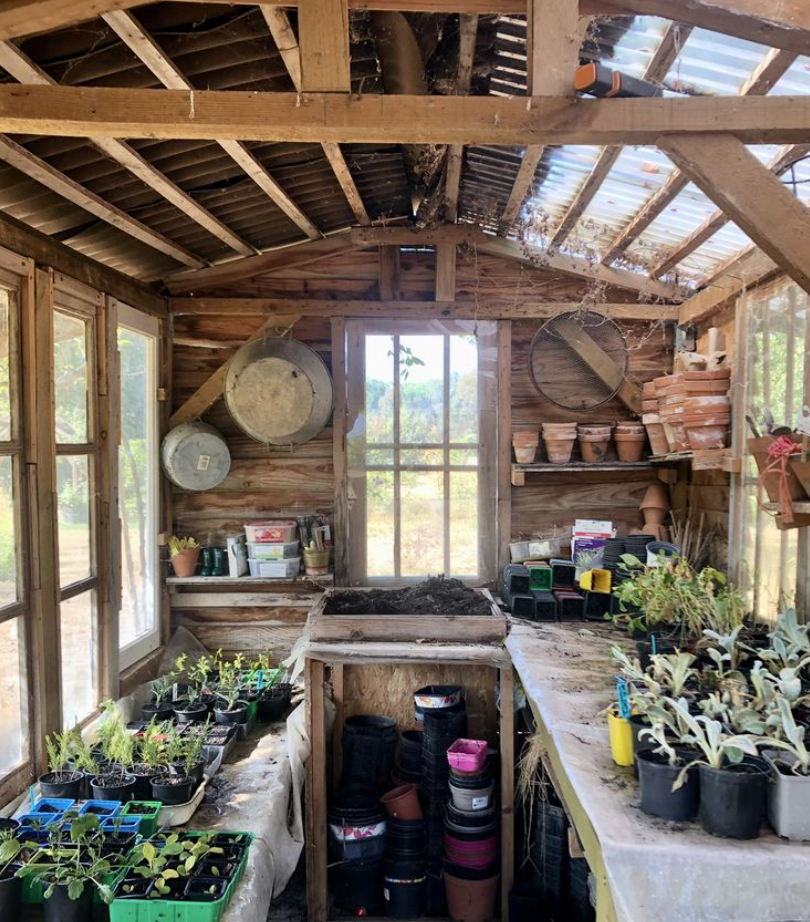
Andrew once told me, see all these hedges they're from one plant. Really? I was in awe that he'd managed to propagate what must have been almost a hundred privets. I'd never worked on such a large property and I quickly realised that garden design takes a lot of resources, especially on that scale. It can be overwhelming if you don't have thousands to fork out on new plants but honestly you can get ahead and it's all part of the succession I mentioned earlier. I'm not sure I'm allowed to endorse stealing cuttings on the internet but... However you acquire them, cuttings are amazing! Simply have a search on the internet to find tips for the specific plant you're looking to propagate and away you go, sometimes it's as easy as shoving a sprig in the ground and crossing your fingers.
I have to preface my hoarding point by saying, soil building resources NOT THINGS. We do not need a tip shop in the backyard, I've worked on enough farms to see this happen every single time. What I mean by resources are things like manure, wood chips, soil, rocks, even brush or twigs from pruning. Unless it's a spreading weed, keep it for building fertility with! I wish I'd done this more in my time at Stone Walls as building the soil was a constant challenge.
Lastly, take your time to observe the garden, I used to think that simply observing wasn't productive but oh how wrong I was, now I could stand for hours with a cup of tea, taking it all in. All good designs are born of careful observation. So take your time and enjoy the process. After all, a garden is never done.

Maya Carroll-Tischler


Comments